

Laser lenticule extraction alters the refractive power of the cornea without creating a corneal flap, as is the case with LASIK. The procedure is known by the trade names SMILE, CLEAR or SmartSight and has been in use since 2011. It corrects short-sightedness and astigmatism. Compared with the established procedures Femto-LASIK and Trans-PRK, it offers only minor advantages, but entails additional, procedure-specific risks.
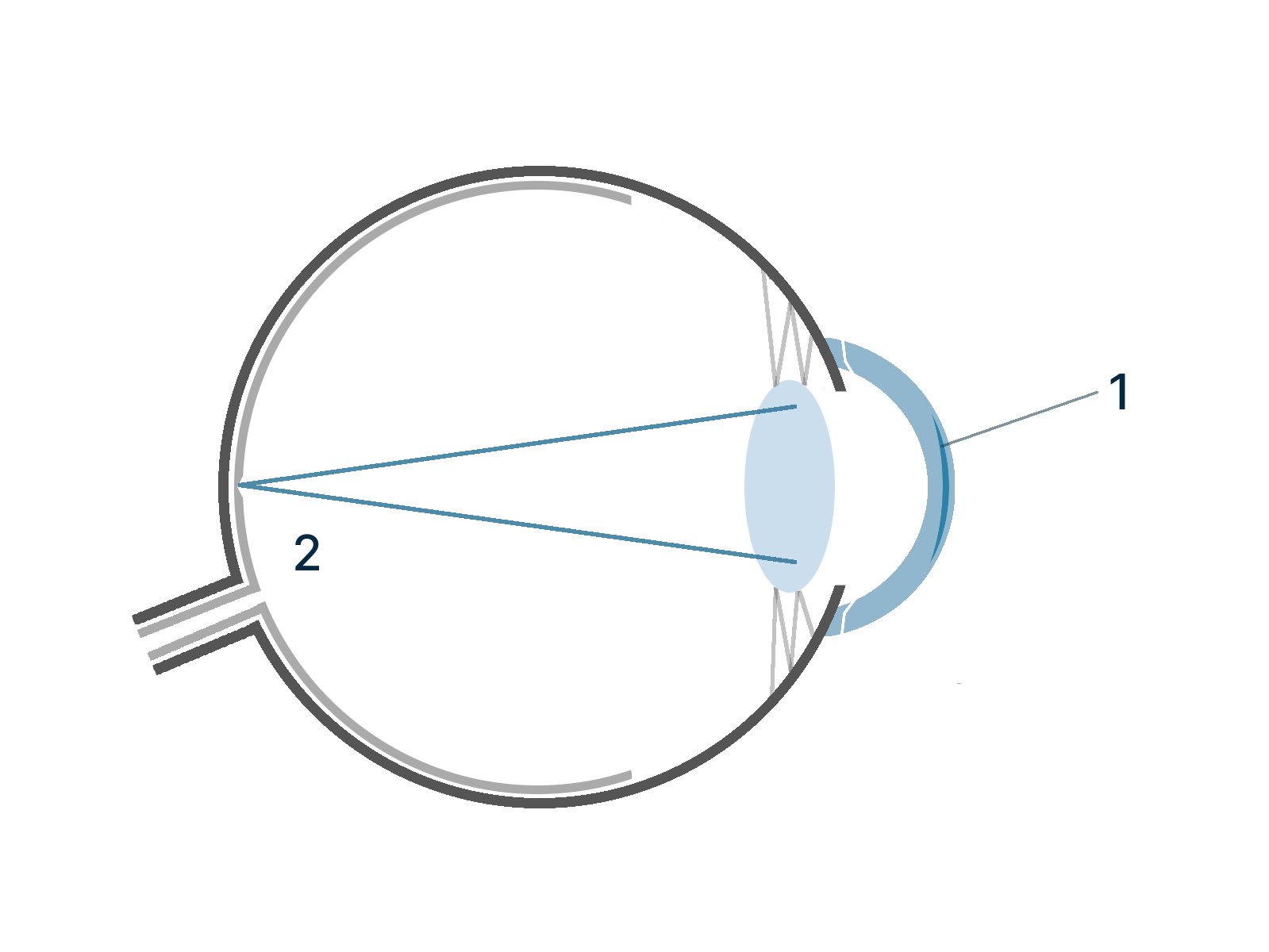
A femtosecond laser cuts a thin disc (lenticule) from within the cornea. This disc is then detached from the cornea via a small lateral incision measuring just a few millimetres and removed. This alters the curvature of the cornea and thus its refractive power, in a similar way to Femto-LASIK or Trans-PRK.
This procedure cannot yet be used to treat long-sightedness on a routine basis. Femto-LASIK or Trans-PRK are the tried-and-tested methods in this regard.
Trans-PRK also offers both of these advantages, as it does not involve the creation of a flap either. In terms of visual acuity, laser lenticule extraction has performed less well than modern Femto-LASIK in recent comparative studies (see below).
Yes, in several respects. With laser lenticule extraction, there are complications that do not occur in this form with Femto-LASIK and Trans-PRK:
Many of these complications depend heavily on the surgeon’s experience.
Recent comparative studies involving the latest generation of equipment suggest otherwise. Following laser lenticule extraction, visual acuity is, on average, poorer than after modern, individually calculated Femto-LASIK, and it takes longer for patients to see clearly.
In a study in which 60 patients had one eye treated with Femto-LASIK and the other with laser lenticule extraction, 98 per cent of the LASIK eyes achieved very high visual acuity after three months, compared with only 82 per cent of the eyes treated with lenticule extraction. The target correction was precisely achieved in all LASIK eyes, but only in around three out of four eyes following lenticule extraction.
A follow-up correction is more complex after laser lenticule extraction than after Femto-LASIK or Trans-PRK. The procedure itself cannot be repeated on the same eye. Follow-up correction is carried out either by means of a surface treatment (PRK), which involves a longer and more uncomfortable healing process, or by subsequently converting the existing incision into a LASIK flap.
Eye Zurich does not offer laser lenticule extraction. The reason is the balance of benefit and risk: the advantages over Femto-LASIK and Trans-PRK are small, the additional risks are not.
It is the most recent of the established laser eye surgery procedures. However, newer does not necessarily mean better: Femto-LASIK and Trans-PRK have been tried and tested for decades, with millions of procedures carried out and very good long-term results.
Yes. However, if you do contact sports or your job carries a risk of blows to the eye, Trans-PRK is also a good choice: it does not require a flap and has no additional procedure-specific risks.
This depends on your vision problem, the thickness and shape of your cornea, your job and your leisure activities. Ask for the pros and cons of the different procedures to be explained to you in a consultation.
This article is no substitute for a consultation with a doctor. Please consult an ophthalmologist to determine which procedure is suitable for your eyes.


