

Vitreous floaters, also known as “mouches volantes”, are usually harmless. For some people, however, they are very bothersome in everyday life, for example when reading, working at a screen or looking at a bright background. In laser vitreolysis, these opacities are broken up or partially dissolved in a targeted way using a special YAG laser. The treatment is performed on an outpatient basis and takes only a few minutes.
Vitreous floaters are small condensations of collagen fibres in the vitreous body of the eye. They usually develop as a result of age-related changes or a posterior vitreous detachment (1). The opacities cast shadows on the retina. Those affected see them as moving dots, threads or strands, especially against a bright background. Because the opacities move with every eye movement, they can significantly impair focused vision.
The YAG laser works on the principle of photodisruption. The laser energy creates tiny, precisely targeted micro-explosions that mechanically break up or partially vaporise the opacities. The energy acts only within the vitreous and not on the surface of the eye.
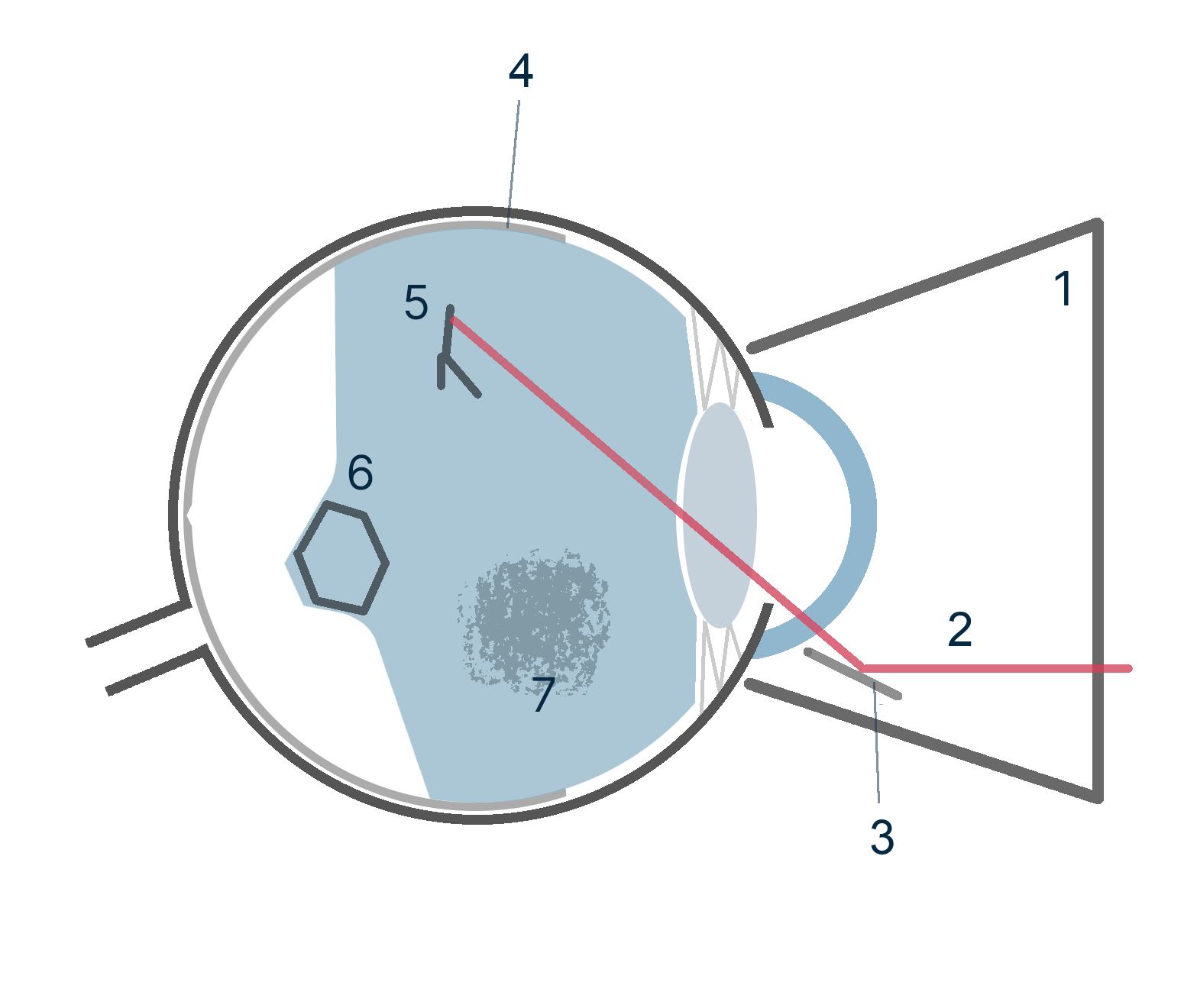
Success depends strongly on the type of opacity. Dense, well-defined opacities, such as a so-called Weiss ring after a vitreous detachment, respond much better than diffuse, widespread haze. In randomised trials, treated patients reported an improvement in their symptoms more often than patients who received a sham treatment (2, 3). Overall, however, the scientific evidence is still limited (4, 5).
Several sessions are often needed to achieve the desired result. With diffuse opacities, the hoped-for improvement may not occur. Since the vitreous is constantly changing, new opacities can also appear at any time.
Vitreolysis is a gentle procedure. As with any eye procedure, however, complications are possible (5):
We will be happy to discuss any open questions with you in person during the consultation.
Vitreolysis is not included in the Swiss tariff catalogue (TARDOC) and is therefore not covered by health insurance. The cost is CHF 300 per eye per session. The preliminary and follow-up examinations, on the other hand, are covered by health insurance.
1. Milston R, Madigan MC, Sebag J. Vitreous floaters: Etiology, diagnostics, and management. Surv Ophthalmol. 2016;61(2):211–227. Link
2. Shah CP, Heier JS. YAG Laser Vitreolysis vs Sham YAG Vitreolysis for Symptomatic Vitreous Floaters: A Randomized Clinical Trial. JAMA Ophthalmol. 2017;135(9):918–923. PubMed
3. Ludwig GD, et al. Efficacy and safety of Nd:YAG laser vitreolysis for symptomatic vitreous floaters: A randomized controlled trial. Eur J Ophthalmol. 2021;31(3). PubMed
4. Kokavec J, et al. Nd:YAG laser vitreolysis versus pars plana vitrectomy for vitreous floaters. Cochrane Database Syst Rev. 2017;(6):CD011676. PubMed
5. National Institute for Health and Care Excellence (NICE). YAG laser vitreolysis for symptomatic vitreous floaters. Interventional procedures guidance IPG741. Link
6. Ankamah E, et al. Dietary Intervention With a Targeted Micronutrient Formulation Reduces the Visual Discomfort Associated With Vitreous Degeneration. Transl Vis Sci Technol. 2021. Link


